
Strategity.AI Value-Based AI Transformation Framework
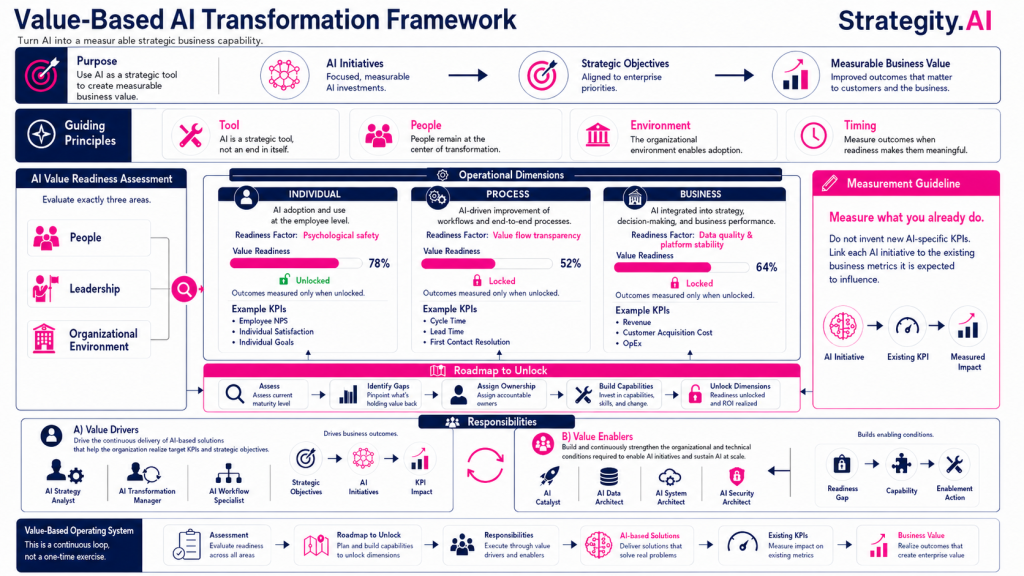
The Framework helps organizations move beyond isolated AI experiments and transform artificial intelligence into a measurable business capability. Rather than treating AI as a technology project, the framework provides a structured approach to embedding AI into the way people work, processes operate, and business decisions are made—creating sustainable, measurable business value.
Built on the principles that AI is a strategic tool, people remain at the center, the right environment enables adoption, and timing determines the rhythm, the framework organizes AI transformation across three independent operational dimensions—Individual, Process, and Business. Each dimension serves a different purpose, evolves independently, and is measured through its own set of success metrics.
The framework helps leaders understand where AI creates value, how that value should be measured, and when business impact can realistically be expected. By distinguishing between the three operational dimensions, organizations can align expectations with reality—for example, recognizing that improving employees’ prompting skills may increase productivity, but will not, by itself, drive revenue growth.
To support this, the framework introduces the Unlock Rule—a readiness principle that determines when a dimension has developed the capabilities required for meaningful measurement. This ensures that organizations measure outcomes only when they are realistically achievable, avoiding premature expectations and enabling management to focus on the metrics that truly matter at each stage of AI transformation.
The result is a practical roadmap that enables organizations to scale AI adoption with confidence, prioritize the right initiatives at the right time, and consistently transform AI investments into measurable business value.
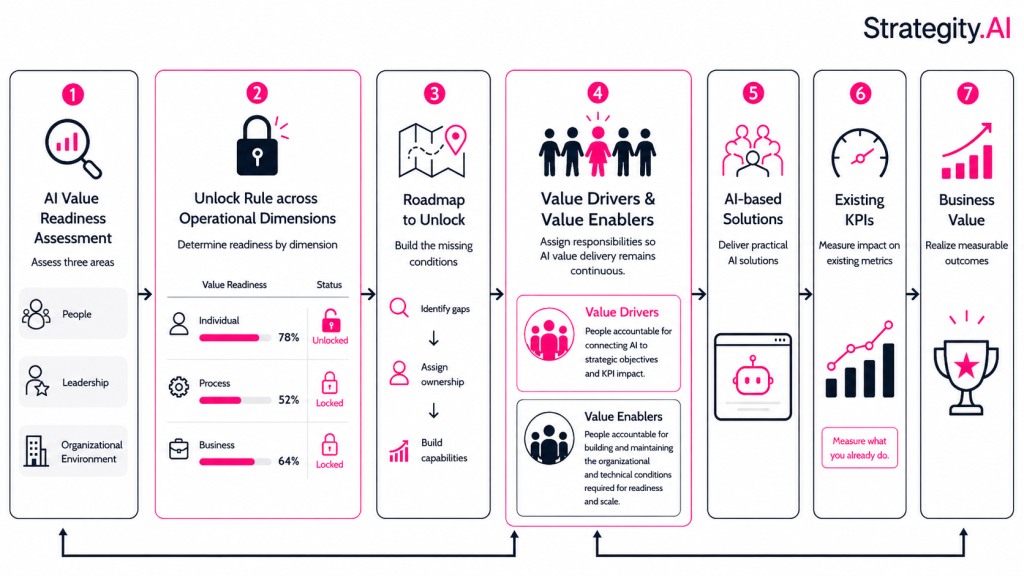
- AI Value Readiness Assessment – assess the current state of People, Leadership, and the Organizational Environment.
- Unlock Rule – each operational dimension—Individual, Process, and Business—receives its own Value Readiness score and Locked/Unlocked status.
- Roadmap to Unlock – identify gaps, assign ownership, and build the capabilities required to reach an Unlocked state.
- Value Drivers & Value Enablers – defined responsibilities keep AI value delivery continuous throughout the transformation.
- AI-based Solutions – deliver practical AI solutions aligned with strategic and business objectives.
- Existing KPIs – measure AI impact through the metrics the organization already uses: measure what you already do.
- Business Value – turn AI initiatives into measurable business outcomes.
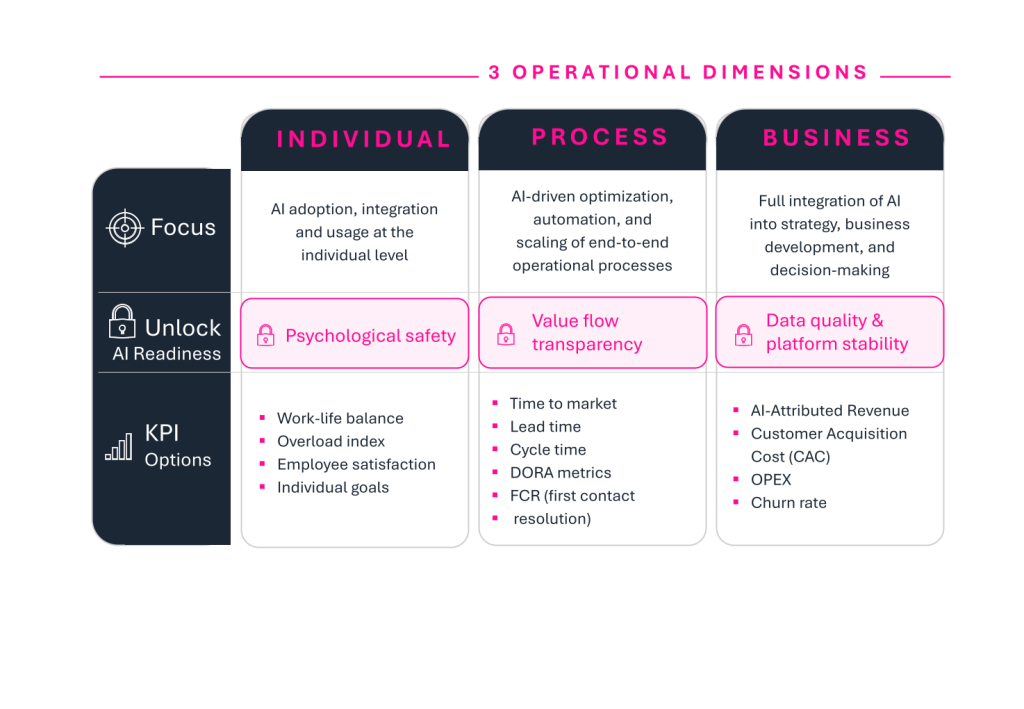
The Three Operational Dimensions
One of the biggest challenges in AI transformation is that organizations often treat every AI initiative as if it should deliver the same type of value. As a result, they frequently expect business outcomes from initiatives that are designed to improve individual productivity, or they measure strategic AI investments with operational metrics.
The Strategity.AI Framework addresses this challenge by distinguishing three independent operational dimensions of AI adoption. Each dimension represents a different way of using AI, creates a different type of value, and therefore requires different success criteria and KPIs.
The three dimensions do not represent maturity levels and they do not build on one another. Organizations can develop them independently, depending on their priorities and business objectives. However, a successful AI transformation requires all three dimensions to receive the appropriate focus, investment, and expectations. Knowing what success looks like at each operational level is the foundation of measurable AI transformation.
Individual Dimension
The Individual dimension focuses on how employees adopt and use AI in their daily work. At this level, AI acts as a personal productivity and decision-support tool, helping people work more efficiently, reduce repetitive tasks, and improve the quality of their output.
Organizations should not expect direct business growth from individual AI adoption alone. Instead, success should be measured through improvements in employee experience and individual performance, such as higher productivity, better work-life balance, reduced burnout risk, increased job satisfaction, and improved quality of work.
The key enabler of this dimension is psychological safety. Employees must feel comfortable experimenting with AI, learning from mistakes, and sharing successful practices without fear of criticism or failure. Without a culture that encourages experimentation, AI adoption rarely scales beyond isolated users.
Process Dimension
The Process dimension moves beyond individual experimentation and focuses on optimizing and automating end-to-end business processes. Here, AI becomes part of the organization’s operational workflow rather than an individual productivity tool.
The critical success factor is value flow transparency. Organizations must avoid optimizing isolated tasks and instead focus on improving complete processes and customer journeys. AI creates the greatest operational value when it removes bottlenecks, reduces handoffs, and improves the flow of work across teams.
Success is measured through operational performance indicators such as time-to-market, lead time, cycle time, DORA metrics, first-contact resolution, and other process-oriented KPIs that demonstrate faster, more efficient execution.
Business Dimension
The Business dimension represents the strategic application of AI. At this level, AI supports business decision-making, opportunity identification, innovation, and the creation of new business value. AI is no longer limited to improving existing work—it actively contributes to shaping strategy and generating competitive advantage.
Organizations can use AI to build new products and services, develop data-driven business cases, improve strategic planning, optimize investments, and enhance executive decision-making. This is the dimension where AI begins to produce measurable commercial impact.
Success is reflected in business outcomes such as AI-attributed revenue, customer acquisition, operational cost reduction (OPEX), customer retention, churn reduction, and other financial or strategic performance indicators.
The key enabler is high-quality, trusted data and a stable AI platform. Without reliable data and scalable technology foundations, AI cannot consistently support business-critical decisions.
Why This Distinction Matters
The success of AI transformation depends on understanding where AI is being used and what type of value it is expected to create.
Expecting revenue growth from employees learning prompt engineering is as unrealistic as expecting an AI-powered business strategy without reliable data or optimized operational processes. Each operational dimension creates a different type of value, progresses at its own pace, and should be measured against its own objectives.
By separating Individual, Process, and Business AI adoption, organizations can define realistic expectations, select meaningful KPIs, and apply the Unlock Rule to determine when each dimension is ready to measure its intended outcomes. This enables leaders to transform AI from disconnected experiments into a structured, measurable business capability.
The Unlock Rule
One of the most common reasons AI transformations fail is that organizations measure outcomes before the necessary capabilities are in place. They expect business impact from initiatives that are still in the early stages of adoption, creating unrealistic expectations and the perception that “AI doesn’t deliver value.”
The Unlock Rule prevents this by introducing a simple readiness principle:
A dimension should only be evaluated against its intended outcomes after it reaches at least 80% AI Readiness.
Until this threshold is achieved, organizations should focus on building the capabilities required for success rather than expecting measurable results. Once the readiness score exceeds 80%, the dimension is considered unlocked, meaning it has the necessary foundation to begin delivering and measuring its expected outcomes.
This approach helps leaders distinguish between capability building and value realization, ensuring that expectations are aligned with organizational readiness.
What AI Readiness Measures
AI Readiness is assessed independently for each operational dimension—Individual, Process, and Business—because each dimension evolves at its own pace and requires different capabilities.
Within every dimension, readiness is measured across three critical transformation factors:
People
People are at the heart of every AI transformation. Unlike traditional technology projects, AI fundamentally changes how employees work, make decisions, collaborate, and create value. Roles evolve, daily workflows change, and new tools become part of everyday work.
These changes naturally create uncertainty, resistance, and fear. Without addressing these human factors, even the most advanced AI technologies struggle to achieve adoption.
The framework therefore evaluates whether employees understand AI, possess the necessary skills, feel confident experimenting with new ways of working, and are willing to embrace continuous learning.
Environment
Successful AI adoption requires an environment that enables employees to use AI safely and effectively.
This includes providing access to the right AI tools, establishing governance and security policies, defining clear usage guidelines, ensuring data availability, and building the technical infrastructure required for responsible AI adoption.
Organizations cannot expect AI transformation without creating the conditions that allow employees to use AI confidently and at scale.
Leadership
Leadership is one of the strongest predictors of transformation success.
Many AI initiatives fail not because of technology, but because leaders remain passive sponsors instead of active participants. Executive commitment must go beyond communication—it requires visible engagement, strategic direction, prioritization, resource allocation, and continuous reinforcement of the desired behaviors.
The framework therefore measures whether leaders actively drive the transformation, communicate a clear vision, define measurable objectives, remove organizational barriers, and lead by example in adopting AI.
Why the Unlock Rule Matters
The Unlock Rule ensures that organizations measure the right outcomes at the right time.
For example, expecting revenue growth from employees experimenting with prompt engineering is as unrealistic as expecting strategic AI-driven decision-making without trusted data or executive sponsorship. Every operational dimension creates a different type of value, and each requires the right conditions before that value can emerge.
By combining AI Readiness with the Unlock Rule, the Strategity.AI Framework helps organizations avoid premature expectations, prioritize capability development, and create a clear path from AI adoption to measurable business value.
Measurement Guideline
Measuring AI transformation is not about introducing new KPIs—it is about measuring the right outcomes at the right operational dimension and at the right time. The Strategity.AI Measurement Guideline provides four principles that help organizations create meaningful and actionable performance measurement.
1. Measure What You Already Track
Avoid creating AI-specific metrics whenever possible. Instead, connect AI initiatives to existing business and operational KPIs that leaders already use to evaluate performance.
This keeps AI aligned with business objectives and makes its impact immediately understandable for decision-makers.
Examples include:
- Time-to-Market
- Lead Time
- Employee Satisfaction
- Customer Acquisition Cost (CAC)
- Revenue
- OPEX
- Churn Rate
The goal is not to prove AI adoption—it is to demonstrate business improvement.
2. Set Target Improvements
Every AI initiative should have a clearly defined expected outcome before implementation.
Rather than asking “Did AI work?”, organizations should define measurable improvement targets such as:
- Reduce Lead Time by 20%
- Increase First Contact Resolution by 15%
- Reduce Customer Acquisition Cost by 10%
- Improve Employee Satisfaction by 8%
AI initiatives become measurable only when success criteria are defined upfront.
3. Apply the Unlock Rule
Before measuring outcomes, verify that the operational dimension has reached the Unlock Threshold.
A readiness score below 80% indicates that the required capabilities are still under development. At this stage, organizations should focus on improving People, Environment, and Leadership rather than expecting business impact.
Only after a dimension is unlocked should its intended KPIs become performance indicators.
This prevents organizations from expecting strategic business results from initiatives that are still in the adoption phase.
4. Focus on Contextual Impact
AI rarely creates value in isolation.
When evaluating results, organizations should consider the broader business context rather than attributing every improvement—or every failure—solely to AI.
Changes in organizational structure, market conditions, leadership decisions, customer behavior, process redesign, or parallel transformation initiatives may all influence business outcomes.
The objective is therefore not to measure AI itself, but to understand AI’s contribution to business performance within its organizational context.
The Measurement Philosophy
The Strategity.AI Framework does not introduce a separate AI scorecard. Instead, it helps organizations answer four fundamental questions:
- What should we measure?
- When should we start measuring it?
- What level of improvement should we expect?
- How much of the observed impact can realistically be attributed to AI?
By following these principles, organizations replace subjective perceptions of AI success with objective, business-oriented evidence—creating a clear link between AI adoption and measurable business value.
Roles
Successful AI transformation is not determined by technology alone—it depends on whether the critical transformation responsibilities have clear ownership across the organization.
The Strategity.AI Framework does not prescribe new job titles or organizational structures. Instead, it defines the key responsibilities required for sustainable AI transformation and ensures that every responsibility has an owner. These responsibilities may be assigned to existing roles or new positions, depending on the organization’s size, maturity, and operating model.
Clear ownership is essential for achieving the Unlock Threshold, removing transformation bottlenecks, and ensuring that AI initiatives deliver measurable business value rather than remaining isolated experiments.
The framework groups these responsibilities into two complementary categories:
Value Drivers
Value Drivers are responsible for maximizing the business value created by AI. Their focus is on identifying opportunities, aligning AI initiatives with business priorities, and ensuring that AI investments translate into measurable outcomes.
Rather than implementing technology, they help the organization answer questions such as:
- Where can AI create the greatest business value?
- Which initiatives should be prioritized?
- What outcomes should be measured?
- Which KPIs define success?
- How should AI initiatives support business strategy?
Typical Value Driver responsibilities include conducting AI assessments, identifying transformation priorities, defining business metrics, building AI roadmaps, supporting leadership decisions, and ensuring that AI initiatives remain aligned with strategic objectives.
Examples include:
- AI Strategy Advisor
- AI Transformation Manager
- AI Workflow Specialist
Value Enablers
Value Enablers create the conditions that allow AI transformation to succeed.
Their primary responsibility is not to generate business value directly, but to ensure that the organization is ready to create it. They establish the technical, organizational, and human foundations required for scalable and responsible AI adoption.
This includes areas such as:
- AI platforms and infrastructure
- Data quality and governance
- Security and compliance
- AI architecture
- Employee enablement and adoption
- Responsible AI practices
Without these enabling capabilities, organizations struggle to move beyond isolated AI pilots and experimentation.
Examples include:
- AI Data Architect
- AI System Architect
- AI Security Architect
- AI Catalyst
Why Both Roles Matter
Many AI transformations focus heavily on either business opportunities or technology implementation—but sustainable success requires both.
Value Drivers ensure that AI is solving the right business problems and generating measurable outcomes.
Value Enablers ensure that the organization has the people, environment, governance, and technology needed to make those outcomes achievable.
Neither group is sufficient on its own. Business value cannot be created without organizational readiness, and organizational readiness has little purpose if it is not directed toward measurable business outcomes.
Together, these responsibilities ensure that every operational dimension—Individual, Process, and Business—can reach the Unlock Threshold and consistently transform AI adoption into measurable business value.